It’s tempting to solve five problems with one install button. Here is why that shortcut almost always leads to long-term headaches for growing businesses.
If you have ever logged into a fresh WordPress installation, you know the temptation. You need SEO. You need security. You need backups, speed optimization, and maybe some marketing pop-ups.
Then you see it: The “All-in-One” plugin suite. It promises to handle everything. It has 5 million active installs. It seems like the easiest, most efficient path forward.
For a DIY hobby blog, those plugins are fine. But when we are building specialized, high-performance websites for clients sites whose uptime and speed directly impact revenue, we have a strict rule: Avoid the mega-suites.
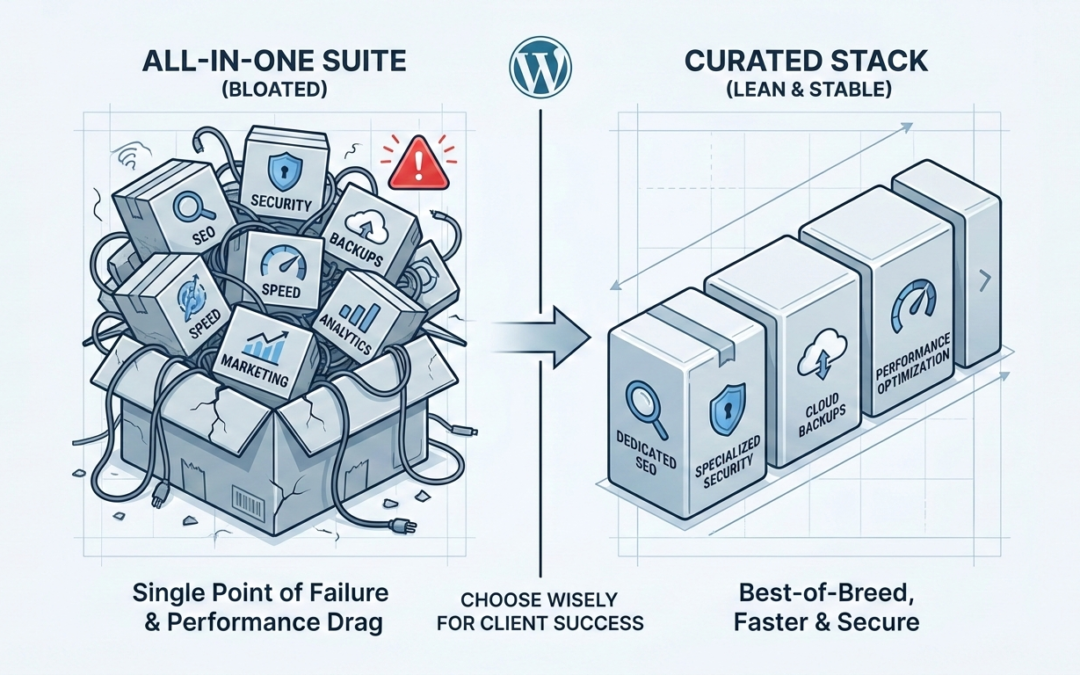
At our agency, we believe in modularity over monoliths. We prefer a curated stack of specialized tools over a single, bloated “kitchen sink” plugin.
Here is the technical and business case for why we take the harder road of curating our stack, and why it results in a better website for you.
1. The Bloat Factor: Features You Don’t Need Slowing You Down
The fundamental problem with an “all-in-one” (AIO) plugin is right there in the name. To appeal to the widest possible audience, they have to include every conceivable feature.
You might install the suite just for its security features, but that plugin is still likely loading the CSS and JavaScript assets for its slideshow module, its related posts module, and its social sharing buttons on every page load.
This is called “bloat.”
In the era of Google’s Core Web Vitals, every kilobyte matters. Unused code increases your Time to Interactive (TTI) and slows down your site for mobile users. We build lean sites that only load exactly what is necessary for that specific page. AIO plugins make that nearly impossible.
2. Jack of All Trades, Master of None
Think about it logically: Can one development team be the absolute best in the world at SEO, and firewall security, and image compression, and database management all at the same time?
Rarely.
An AIO plugin usually offers a “good enough” version of twenty different features. But “good enough” doesn’t cut it in competitive markets.
We prefer the “best-of-breed” approach. We use an SEO plugin built by SEO obsessives. We use a security plugin built by dedicated cybersecurity experts. We want tools built by teams focused singularly on solving one problem perfectly.
3. The Single Point of Failure Risk
When you rely on a massive suite for critical infrastructure, you are putting all your eggs in one basket.
If an AIO plugin pushes a bad update that conflicts with your theme, you don’t just lose your social share buttons, you might simultaneously lose your firewall, your backups, and your site analytics. Your entire operations center goes down at once.
By modularizing our stack, we isolate risk. If our image compression plugin has a hiccup, it doesn’t take down your site security along with it.
4. The “Database Trash” and Lock-In Problem
AIO plugins are notoriously difficult to uninstall cleanly. Because they touch so many parts of your WordPress installation, they often integrate deeply into your database.
When you decide later that you want to switch to a better, specialized solution, removing the old mega-suite often leaves behind thousands of orphaned rows in your wp_options table. This invisible clutter slows down database queries forever.
Furthermore, these suites try to lock you into their ecosystem. They often use proprietary methods instead of standard WordPress functionality, making migrating away from them painful and expensive later on.
5. Debugging Nightmares
When a client site experiences a weird glitch or a sudden performance drop, our job is to find the culprit fast.
When a site is running five specialized plugins, it’s easy to deactivate them one by one to isolate the issue. When a site is running one massive plugin that controls 50 different functions invisibly in the background, debugging becomes a needle-in-a-haystack scenario. This means more billable hours spent troubleshooting and longer downtime for the client.
Our Philosophy: The Curated Stack
We don’t avoid AIO plugins because we hate convenience. We avoid them because we love stability.
We believe in the “Unix philosophy”: Make each program do one thing well.
It requires more expertise on our part to research, test, and integrate a dozen specialized plugins so they work seamlessly together. It takes more effort up-front than clicking “install” on a mega-suite.
But the result is a WordPress site that is leaner, faster, easier to debug, and built on a foundation sturdy enough to scale with your business.