


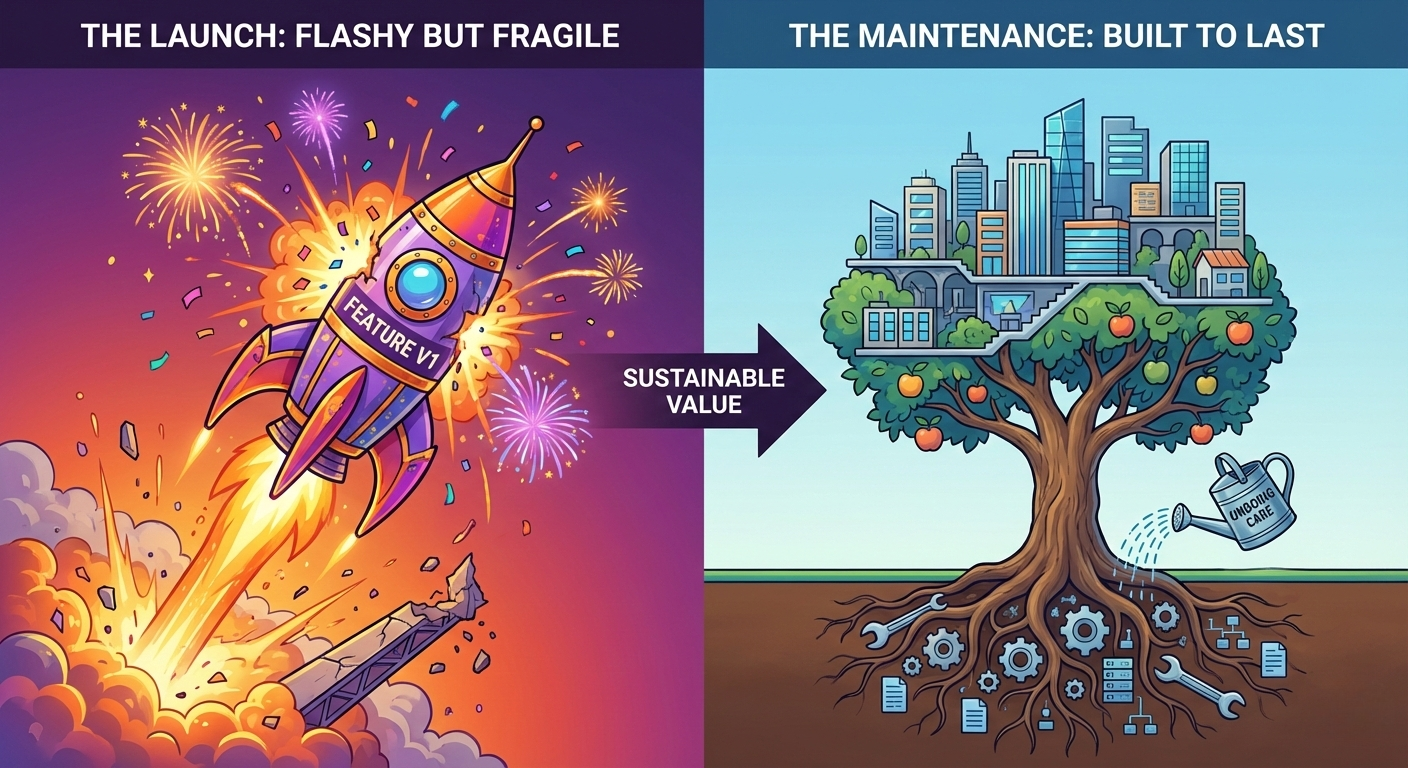
We are addicted to the “sugar rush” of shipping new features. But real product success isn’t defined by the ribbon-cutting ceremony; it’s defined by the years of unglamorous upkeep that follow.
There is an intoxicating energy surrounding a product launch.
The countdown clocks, the finalized feature checklists, the press releases, the “Day 1” excitement. In the software world, the launch feels like the finish line of a marathon. You pushed hard, you crammed in every requested feature, and you finally shipped it. Time for champagne.
But anyone who has managed a successful digital product for more than a year knows a hard truth: The launch is not the finish line. It is barely the starting gun.
In our rush to pack the initial release with “game-changing” features, we often neglect the infrastructure required to support that product next month, next year, and five years from now.
We prioritize the wedding and completely ignore the marriage.
Here is why the unsexy reality of long-term maintenance will always matter more to your product’s success than the sparkle of launch features.
1. Launch Features are Hypotheses; Maintenance is Reality
When you launch V1 of a product, your feature set is essentially a collection of educated guesses. You think users want Feature A. You assume they need Feature B to solve their problem.
You don’t actually know until the product is in the wild.
If you spend 90% of your budget and energy on the launch features, you have nothing left in the tank when reality hits.
Maintenance is the act of listening to reality. It is the process of refining, refactoring, or even removing features based on actual usage data, rather than stakeholder assumptions. A product that can gracefully adapt through robust maintenance will always beat a feature-bloated product that is too brittle to change.
2. The Compound Interest of Technical Debt
Every feature you ship is a liability.
Every line of code you write is something that needs to be tested, debugged, secured, and eventually updated when its underlying dependencies become obsolete.
When teams prioritize “shipping” above all else, they take shortcuts. They hard-code values. They skip writing tests. They ignore messy architecture to meet a deadline. This is technical debt.
At launch, technical debt feels manageable. Six months later, it begins to compound.
Suddenly, adding a simple new feature takes four weeks instead of four days because the developers have to wade through a swamp of brittle code. If you neglect maintenance, your development velocity doesn’t just slow down—it eventually grinds to a halt.
3. Users Churn on Bugs, Not Lack of Features
Think about the last three pieces of software you abandoned.
Did you leave because it didn’t have one specific, niche feature? Or did you leave because it was slow, it crashed unexpectedly, or the interface was confusing?
Users have a baseline expectation of reliability. If your app is buggy, slow, or unstable, it doesn’t matter how revolutionary your feature set is. They won’t stick around long enough to use it.
Long-term maintenance is what ensures reliability. It’s the unglamorous work of database optimization, squashing minor bugs, and improving load times. This work doesn’t get applause at the all-hands meeting, but it is the primary driver of user retention.
4. Security is a Moving Target
Software doesn’t exist in a vacuum. It relies on servers, libraries, APIs, and frameworks.
On launch day, all those dependencies might be secure. Three months later, a critical vulnerability might be discovered in one of them.
If your team is solely focused on the “next big feature” and isn’t budgeting time for routine maintenance and dependency updates, your product is a ticking time bomb.
Maintenance isn’t just about keeping the lights on; it’s about keeping the doors locked. A security breach will destroy your company’s reputation faster than any missing feature ever could.
The Shift in Mindset: From Builders to Stewards
The problem isn’t features themselves; the problem is the imbalance in how we value them. We celebrate the “builders” who ship new things, and we undervalue the “maintainers” who keep those things alive.
To build sustainable digital products, we need a shift in mindset.
- Budget for the “Forever”: Don’t budget for a project; budget for a lifecycle. Allocate 20–40% of engineering time specifically for maintenance, refactoring, and debt pay-down, forever.
- Celebrate Stability: Start recognizing and rewarding the work that improves performance or stability, not just the work that adds new buttons to the UI.
- Ship Less, Maintain More: It is better to launch with three rock-solid, easily maintainable features than ten brittle ones.
A flashy launch gets you an audience for a day. Relentless, unsexy maintenance keeps them for a decade.
0 Comments