


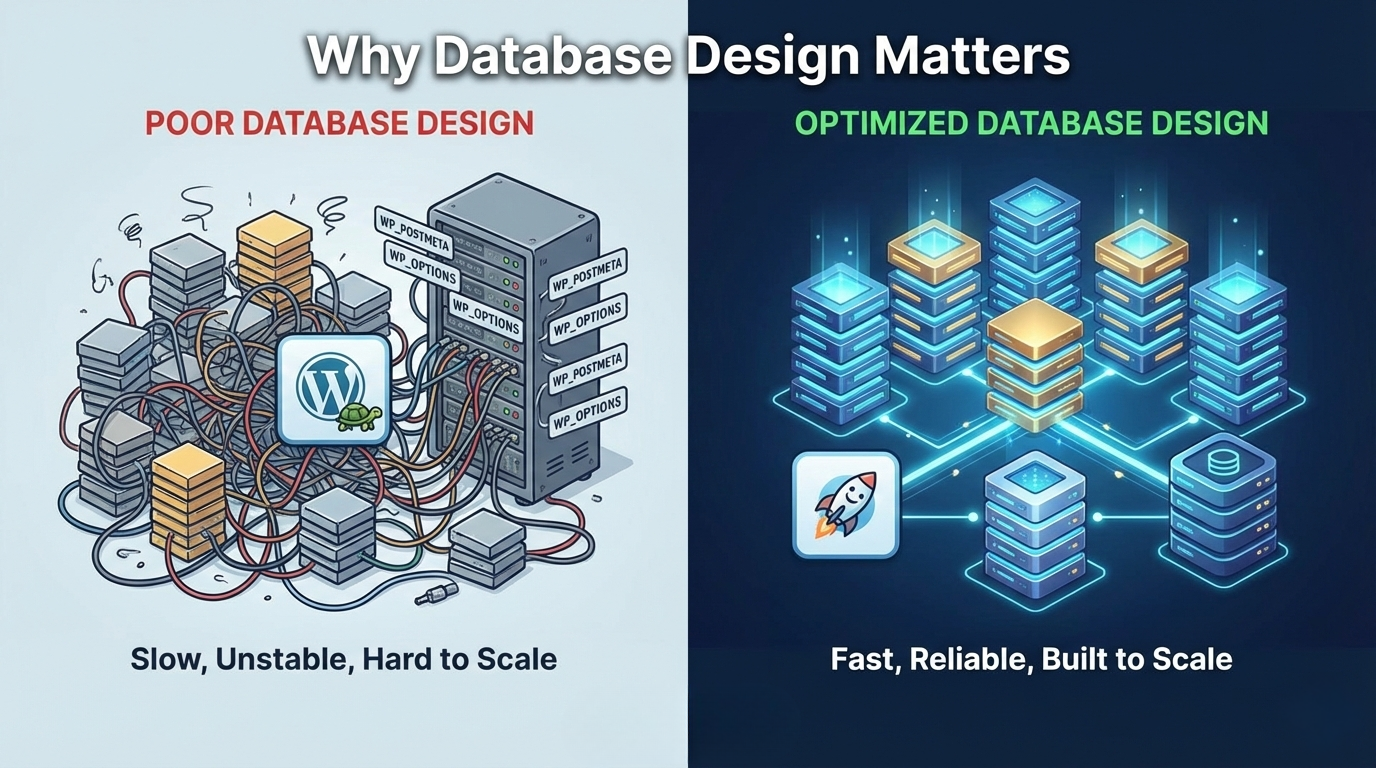
When people talk about a “fast” WordPress plugin, they usually focus on the frontend. They look at how quickly a menu opens or how smooth the animations appear. However, at Scriptudio, we know that true performance is actually decided deep within the database.
A plugin can have the cleanest PHP code in the world, but if the database architecture is flawed, it will eventually bring even the most powerful server to a crawl.
Here is why database design is the most critical part of the development process and how we approach it to ensure long-term scalability.
The “Meta” Trap: Why Standard Tables Aren’t Always the Answer
WordPress comes with a set of default tables like wp_options, wp_posts, and wp_postmeta. For simple features, these are great. But for complex plugins, they often become a performance bottleneck.
Many developers take the path of least resistance by shoving every piece of plugin data into wp_postmeta. This is what we call the “Meta Trap.”
The Problem with Serialized Data
The wp_postmeta table is a “key-value” store. It is not designed for complex searches. If you store a large array of data as a “serialized string” in a single meta row, the database cannot “see” inside that data.
To find one specific value, the server has to:
- Load the entire string.
- Unserialize it using PHP.
- Search through it manually.
This is fine for one user. It is a disaster for ten thousand.
The Scriptudio Blueprint: Custom Tables for Custom Needs
When we build a plugin that handles significant amounts of data—such as a performance profiler, a booking system, or a custom directory—we often step outside the WordPress core tables and build custom database tables.
Here is why this approach wins every time:
1. Granular Querying
With a custom table, every piece of information has its own dedicated column (e.g., price, status, user_id). This allows the database to use its native power to filter and sort data instantly without needing to load unnecessary information into the server’s memory.
2. The Power of Indexing
Think of a database index like the index at the back of a massive textbook. Without it, you have to read every page to find a topic. With it, you go straight to the page number. Proper indexing on custom tables can turn a three-second query into a three-millisecond query.
3. Data Integrity
Core WordPress tables don’t know your data’s “rules.” With custom tables, we can set strict requirements. We can ensure that a “price” column only accepts numbers or that a “status” column only accepts specific words. This prevents “dirty data” from breaking your site months down the road.
Scalability: Designing for the Future
A common mistake in plugin development is “designing for the demo.” A plugin might look fast when it has ten rows of data in the database. But what happens when your business grows?
At Scriptudio, we stress-test our database designs with hundreds of thousands of rows of dummy data. We look for the “tipping point” where queries start to slow down. If a query takes more than 50ms, we rewrite the architecture.
Our Checklist for Every Project:
- Normalization: We structure data to avoid redundancy.
- Optimal Data Types: We use the smallest possible data type for each column to keep the database footprint lean.
- Efficient Cleanup: We include automated “pruning” logic to delete old, useless logs so your database doesn’t grow indefinitely.
The Bottom Line
A well-designed database is invisible. You only notice it when it’s done poorly—when your site lags, your reports take minutes to load, or your server crashes during a traffic spike.
By investing in professional database architecture at the start, you aren’t just building a feature; you are building an asset that can grow alongside your business without ever slowing you down.
Is your current plugin setup struggling under the weight of your data? Let’s take a look under the hood. At Scriptudio, we specialize in refactoring and optimizing database layers for peak performance.
0 Comments