


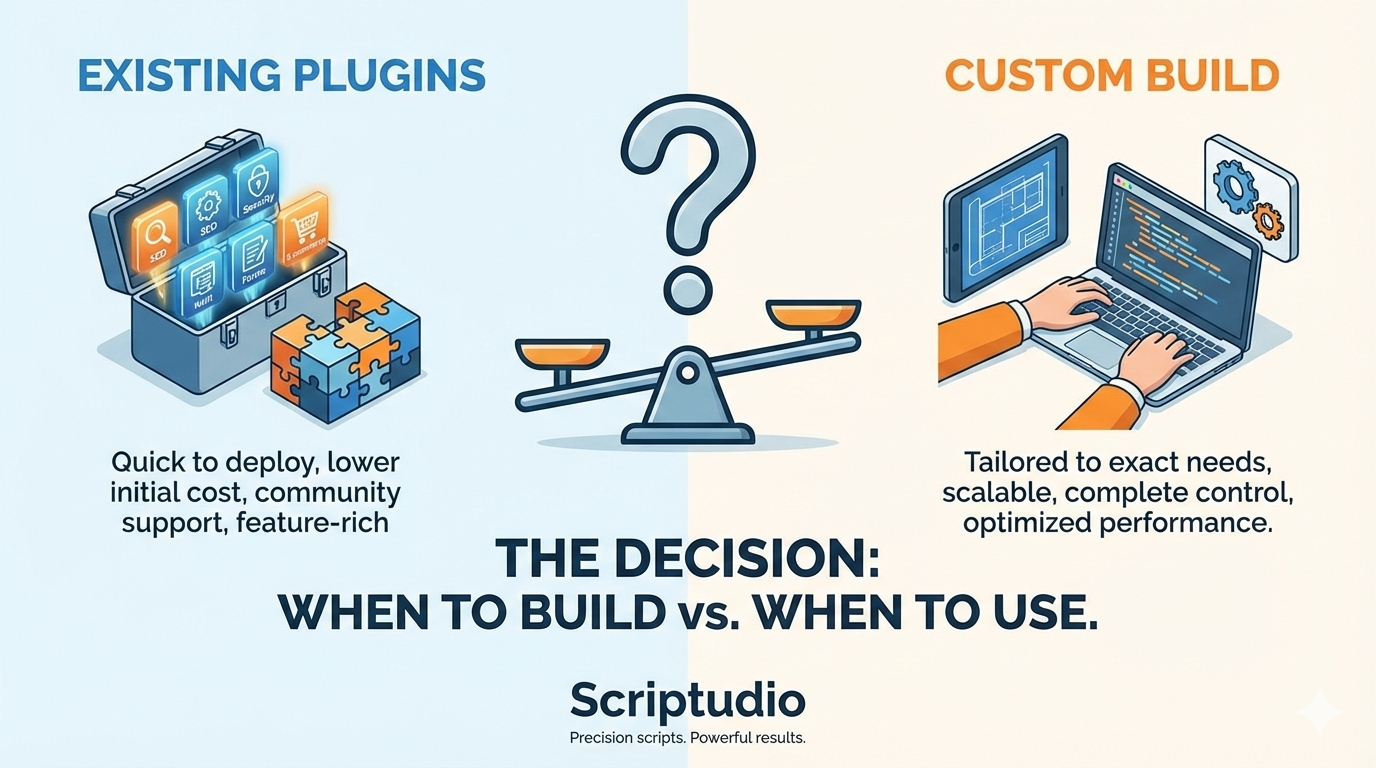
At Scriptudio, almost every new client engagement begins with a variation of the same question:
“We need a specific feature for our platform. Should we just grab an existing plugin, or do we need you to build it from scratch?”
The answer, unfortunately for those who like quick fixes, is rarely a simple “yes” or “no.” It’s never just a technical decision; it is a business strategy decision. It involves balancing immediate budget constraints with long-term scalability, and deployment speed with performance requirements.
Making the wrong choice can be costly. Choosing an existing plugin that doesn’t quite fit can lead to a bloated, slow website held together by “hacky” workarounds. Conversely, building a custom solution for a standard problem is a waste of time and money.
As specialists in WordPress, WHMCS, and Laravel development, we navigate this crossroads daily. Here is an inside look at how we help our clients decide which path to take.
Path 1: The Case for Existing Plugins (The “Off-the-Shelf” Route)
Think of this like buying a suit off the rack. It’s quick, it’s relatively affordable, and if you have a standard build, it will probably look great with minor alterations.
In the WordPress and WHMCS ecosystems, there are thousands of brilliant, well-maintained plugins that solve common problems. We are not in the business of reinventing the wheel.
When We Recommend Existing Plugins:
-
Standard Functionality: If you need standard e-commerce (WooCommerce), basic SEO tools, or standard contact forms, existing solutions are mature and battle-tested.
- Speed to Market is Critical: If you need a feature live tomorrow to test a business hypothesis, an existing plugin is your best bet.
- Budget Constraints: The initial cost of setting up an existing plugin is almost always lower than custom engineering.
The Hidden Risks:
The downside of off-the-shelf is “feature bloat.” A plugin designed to satisfy 100,000 different users often includes 90% functionality you don’t need, which loads unnecessary code and slows down your site. You are also dependent on the original developer for security patches and updates.
Path 2: The Case for Custom Build (The “Tailored” Route)
This is like commissioning a bespoke suit. It involves multiple measurements and fittings. It costs more and takes longer, but the final product fits you perfectly and is made of higher quality material.
This is Scriptudio’s sweet spot. Whether it’s a lean WordPress plugin tailored to a unique workflow, a specific WHMCS provisioning module, or a full-scale Laravel application, custom builds are about precision.
When We Recommend Custom Development:
- Unique Business Logic: Your business process is your competitive advantage. If an existing plugin forces you to change your successful workflow to match its limitations, you need custom code.
- Performance is Paramount: We build custom solutions that do exactly what they need to do, and nothing else. No extra CSS, no unnecessary JavaScript, no redundant database queries.
- Long-Term Scalability & Ownership: You own the code. You aren’t relying on a third-party developer who might abandon their plugin next year. You control the roadmap.
- Integration Complexity: When you need your site to talk to three different external APIs in a very specific way, a custom bridge is usually safer and more stable than trying to force multiple existing plugins to cooperate.
The Scriptudio Decision Framework
So, how do we actually make the call when a client comes to us? We move past the code and look at the business case using a few key criteria:
1. The “80/20” Rule and the Frankenstein Effect
Does an existing plugin do 80% of what you need? If so, can your business live without the remaining 20%?
If the answer is “no,” we have to be very careful. Trying to take an existing plugin and heavily modify its core code to bend it to your will often results in a “Frankenstein Monster”—it’s unstable, hard to update, and breaks easily. In these cases, building custom from scratch is often cleaner and cheaper in the long run than trying to hack an existing product.
2. The Long-Term ROI Calculation
We ask our clients: “Where will this feature be in two years?”
If it’s a temporary marketing campaign, use a plugin. If it’s a core feature that your entire business operations will rely on for the next decade, invest in custom architecture. The upfront cost is higher, but the Total Cost of Ownership (TCO) over five years is often lower because you avoid constant bug-fixing and conflict resolution.
3. The Criticality Assessment
How mission-critical is this feature? If a contact form plugin breaks, it’s annoying. If your WHMCS billing module breaks because of a third-party update, you lose revenue. For high-stakes, mission-critical infrastructure, custom code that we control and test rigorously is usually the safer choice.
Conclusion: The Right Tool for the Job
At Scriptudio, our goal isn’t to sell you the most expensive custom project. Our goal is to provide the right solution that helps your business grow efficiently. Sometimes that means configuring an excellent off-the-shelf plugin, and sometimes it means firing up our code editors to build something unique.
Are you stuck at this crossroads with your next project? Contact us today. Let’s talk through your requirements and find the path that makes the most sense for your business.
0 Comments